
“vRealize” Today’s enterprise businesses have become more dependent on digital infrastructure and monitoring tools to ensure that their operations are smoothly carried out. Managing things like virtualmachines, monitoring nimbuhub environments, and other virtual/cloud tasks require robust infrastructure platforms that are user-friendly and reduce complexities. This need for intelligent infrastructure management has led several companies to adopt sophisticated virtualization and automation platforms for satisfying their modern workloads.
A platform that has gained much popularity within enterprise IT is the vRealize platform. Designed to assist customers in handling their virtual systems in a more efficient way and automating time-consuming tasks, this platform contributed to a great extent to the enhancement of system capacity and knowledge transparency in many IT environments worldwide, both small and large, primarily in enterprise data centers or hybrid cloud environments.
In today’s changing technology environments, Companies are facing the challenge of The need for stability, Scalable systems and Cost control, all at the same time. Enterprises are resorting to automation and cloud management platforms due to this very need. A basic understanding of its working, application in the enterprise and its future can be helpful to IT professionals and Executives alike, in this regard.
Also Read: The Fascinating Mystery of Dentiloquent Speech
Understanding the Core Purpose of vRealize
VRealize was designed to make management of environments built upon virtualization or cloud easier. Often it is difficult for businesses to keep track of the infrastructure they have due to the fact it is spread across various servers and applications in either their own data center or the cloud. On top of this there is no way to manage all this easily without some sort of integrated platform.
Organizations can use it to automate routine activities that could not only incur significant time and financial costs but also be a drain on operational resources. For instance, operations that involve provisioning VMs, tracking system health and elasticity, or monitoring current trends or the overall infrastructure performance can all be automated with ease. Automation means protocols are carried out in this computing environment smoothly without the need of human intervention.
The platform also offers significant operational intelligence. IT users can use it to monitor performance metrics over time, catch inefficient resource-usage patterns, and anticipate shortages that would harm operational stability in advance. This enables them to not only assure generally stable environments but also enhance their planning capabilities in the long term. Integrating monitoring, automation, and analytics into a single framework allows organizations to more effectively manage their infrastructure without additional administrative overhead.
How vRealize Supports Modern Cloud Environments
Cloud computing has revolutionized Business Application Deployment & Management. Enterprises are moving to a hybrid & multi Cloud Environment, rather than sticking to Hardware platform operated from buissness data center. Managing such distributed environment/ workload balancing across private or public cloud became cumbersome. And here vRealize proved to be boon for Enterprise IT teams.
By having one easy-to-use framework for managing several cloud environments, the user will be able to be manage all the workloads from a single location. This will make managing several clouds simpler and more consistent (no need to use different management infrastructures). A company can avoid delays when deploying applications and spending more time on allocating resources and monitoring what is happening in the cloud.
Operational controls are also enhanced through the adoption of automated cloud management systems. Rather than needing to interrupt live applications and react to rapidly increasing traffic or workload conditions through manual actions, automated policies can be put in place to automatically increase or decrease scale to meet user demand. This type of flexibility ensures better application performance and enables companies to stray from over provisioning resources. As cloud adoption increases platforms that manage hybrid infrastructure in the most efficient way become more and more relevant across all sizes of businesses.
The Role of Automation in Enterprise Operations
Automation has been one of the most critical topics that modern IT administrators need to address. A typical large enterprise manages a significant number of virtual machines, applications, and infrastructure simultaneously. Doing timely and mundane administration manually involves a lot of effort and may lead to configuration errors. Automated platforms can provides solutions for those repetitive task with uniform environments.
By integrating automation into your workflow, one of the most significant advantages is the speed in deploy infrastructure. Rather than administrators login to each of your systems and manually provision the various components, the processes are automated and completed in a matter of minutes. This means your development teams will be able to get their infrastructure requirements sooner and your time to market will be enhanced. Improvements in cycle times do enable your business to adapt more readily to changing needs.
Automation also leads to improved operational dependability. Companies may implement rules and workflows to apply uniform configurations in each environment that mitigate irregularities subsequently causing operational or security problems. Infrastructures can have predetermined policies for provisioning, monitoring, and routine procedures which allow for more predictable operation than a meso-scale enterprise environment would typically facilitate.
Key Components and Features of the Platform
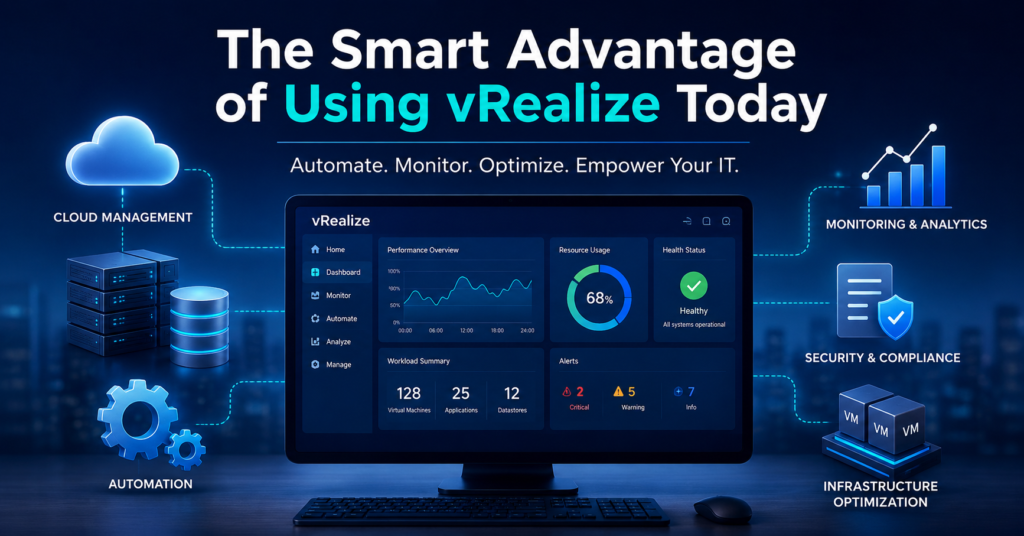
The platform also offers various modules tailored to diverse infrastructure issues. A significant element centers on operation monitoring and analysis, supplying developers with real time information about system status, usage and application functions. Such data empower personnel to troubleshoot emerging issues promptly and maximize performance by preparing workloads for upcoming demand.
The second key aspect involves automating the overall infrastructure. With infrastructure automation, companies enable self-service portals to let users log requests for needed resources, but without burdening administrators with all procedures. Automating approval processes, provisioning mechanisms and policy-driven configurations help delivering infrastructures with better control, governance and security, but also with greater efficiency.
Log collection and troubleshooting tools is another integral part of the ecosystem. System administrators are able to gather and analyze logs from multiple systems in one, centralized location. This enables quickly troubleshooting problems and unusual activities, which in turn minimizes downtime and ensures system stability. The integration of monitoring, automation, analytics and log management tools results in better managed infrastructure.
Also Read: The Remarkable Rise of dfcbktr in Digital Culture
| Feature | Primary Purpose | Business Benefit |
|---|---|---|
| Performance Monitoring | Tracks infrastructure health | Reduces downtime |
| Automation Workflows | Automates repetitive tasks | Saves administrative time |
| Resource Management | Optimizes infrastructure usage | Improves cost control |
| Log Analytics | Centralizes troubleshooting data | Speeds up issue resolution |
| Self-Service Provisioning | Allows faster resource requests | Improves operational efficiency |
Why Businesses Invest in Intelligent Infrastructure Management of vRealize
Manufacturers and corporations have as priority the implementation of infrastructure management platform solutions; because of the direct relation between operational effectiveness and company innovation. Breakdowns, capital squander and execution failures are followed by huge costs and loss of efficiency. These companies are willing to find solutions that give better IT resources awareness, tracking and due separation.
Scalability business makes use of the sophisticated management platform is. When organizations grow larger, infrastructure requirements grow more rapidly. If business do not implement a central management and automating environment in place, they will encounter tremendous difficulties and costs in scaling such an environment. Intelligent management systems enable business to scale-up infrastructure and guarantee ceaseless operation, productivity and performance. This feature is wished for by business having a fast digital development pace.
Cost management also heavily impacts adoption. Companies have trouble managing oversubscribed resources and using infrastructure efficiently, especially when they are using the cloud. Cost-reporting tools and other advanced analytics enable organizations to find inefficient infrastructure to see where they are wasting costs and cut back. This process saves money and improves efficiency without sacrificing infrastructure reliability.
The Evolution from Traditional IT Management
IT management in the past was predominantly comprised of manual administration and siloed infrastructure. This meant manually setting up servers, managing environments with disparate tools and troubleshooting without visibility of the whole system. This was fine for a limited infrastructure but was difficult to implement and manage on increasing scale.
The proliferation of virtualization and cloud ushered in a whole set of new challenges that traditional approaches to management simply could not solve. While data centers grew in size and capacity, workloads in those data centers became increasingly dynamic and applications moved between clouds and the data center. The infrastructure itself became more complex than ever before. Companies sought management solutions that could cope with increasing automation, analytics, multisite and wireless adoption as well as consolidating monitoring across growingly distributed environments.
Today, infrastructure management markets have come a long way from traditional reactive troubleshooting. Now, with tools that support predictive analysis and automated action-triggered workflows an enterprise can prevent infrastructure problems, rather than reacting to them. Infrastructure management is made much more stable and less burdensome by the move to automation driven infrastructure management.
How IT Teams Benefit from Centralized Visibility of vRealize
Managing an environment using management platforms and tools can become very complex, especially where responsibility is shared across numerous systems. Where administrators have an insight into the end-to-end operation from a single point of control, managing such systems becomes far easier. Cloud administrators can, for example, access a single management tool that shows the overall operation rather than accessing various monitoring tools for servers, applications, storage and cloud workloads.
Another benefit of centralized visibility is making decisions easier. Through aggregates and analytics, administrators can gain a high-level view of how the corporate infrastructure was performing, what the usage patterns were, and where application activity was concentrated. With this knowledge, organizations are able to deal with capacity planning in a more informed way – without fear of running out of resources or running into a performance issue.
Improves the speed of incident resolution. The centralized management and logging tools allow system administrators to initiate faster diagnosis once an issue happen. For the business enterprise, this aspect of the solution is critically essential in this age of high income-earning and customer-satisfying server services.
Security and Compliance Considerations of vRealize
Security is another major challenge for organizations who manage large infrastructure environments; as infrastructure becomes more interconnected and clouds become more prevalent, organizations are under mounting pressure to protect critical data and ensure effective management. Infrastructure management platforms can be vital in ensuring security policies are enforced and governance is maintained.
Enforcing policy automatically allows managers to define policy constraints for controlled deployment, access to resources and operational parameters. So, system administrators need not to remember each and every configuration and it increases the probability of avoiding human errors reducing the chances of security breaches or violations.
The centralized visibility and reporting provided by infrastructure management is also helping to make compliance easier. Many businesses doing business in regulated industries require traceability and audit trail on their operations. Infrastructure management tools will be able to preserve audit logs, track activity, and generate reports to support their compliance obligations.
The Future of Infrastructure Automation and Management of vRealize
Over that same period, technology environments have evolved and the tools that manage infrastructure need to adapt to business requirements as they change. Today, new tools utilizing more artificial intelligence, machine learning, and predictive analytics provide the ability to see trends, anticipate failures, and automate decisions in ways traditional tools cannot.
Hybrid Cloud environments will continue to be important to enterprises for years to come. Organizations want the flexibility of infrastructure models that utilize private and public cloud resources, and those that can manage multiple environments from a single administrative platform will be vital in providing the traditional agility that organizations require.
There are unlikely to be any easing off on the pressure for operational efficiency in the future. Efficiencies need to be found not just in work practices but also in cost control and assurance of infrastructure performance. Intelligent automation, centralized analytics and a scalable management platform will remain vital for enterprise IT strategies as digital transformation continues to unfold.
Conclusion
Managing the modern IT infrastructure is going to be difficult in ways that were only distant dreams of a decade ago. Today businesses operate in hybrid cloud environments, virtualization, ever adapting digital environment that need continuous monitoring and control. Platforms designed with a goal of easing out this operation have become critical for businesses wanting to keep their IT systems consistent, scalable and optimized.
VRealize was known for using automation to allow organizations to unify infrastructure provisioning, response, and management, significantly reduce need for manual intervention, and collect comprehensive data and reporting for increased oversight. Its integrated tools for monitoring, analytics, automation, and management was effective in assisting organizations to juggle expansive infrastructure environments.
In the ongoing development of enterprise infrastructure, the need for a comprehensive, intelligent management solution remains ever-critical. It is essential to have a single, integrated management platform that can help a business maintain on-demand cloud adaptability, efficient and reliable service and operational stability, and enable proactive (not reactive) decision making process in an ever-more-fluctuating enterprise environment. It is therefore important to comprehend the significance that this kind of a platform would have.
Also Read: So what’s the fuss with Dubolsinho?
FAQs
What is vRealize mainly used for?
Mainly for cloud management, infrastructure automation and capabilities, monitoring, analytics and operation management in enterprise IT.
Is vRealize only for large enterprises?
Although the most common use is by large companies, medium enterprises with Virtual infrastructure more complex can use this system too, you can find many points of automation and easy monitoring.
Does vRealize support hybrid cloud environments?
Yes, its features allow it to support hybrid and multi-cloud environments by providing centralized visibility and control of operations.
Why is automation important in infrastructure management?
Automation eliminates work requiring human intervention, accelerates deployment, safeguards against errors, and promotes uniformity of operation.
Has VMware changed the vRealize product names?
Yes, some of the products within the suite were subsequently renamed following the VMware Aria nomenclature;