
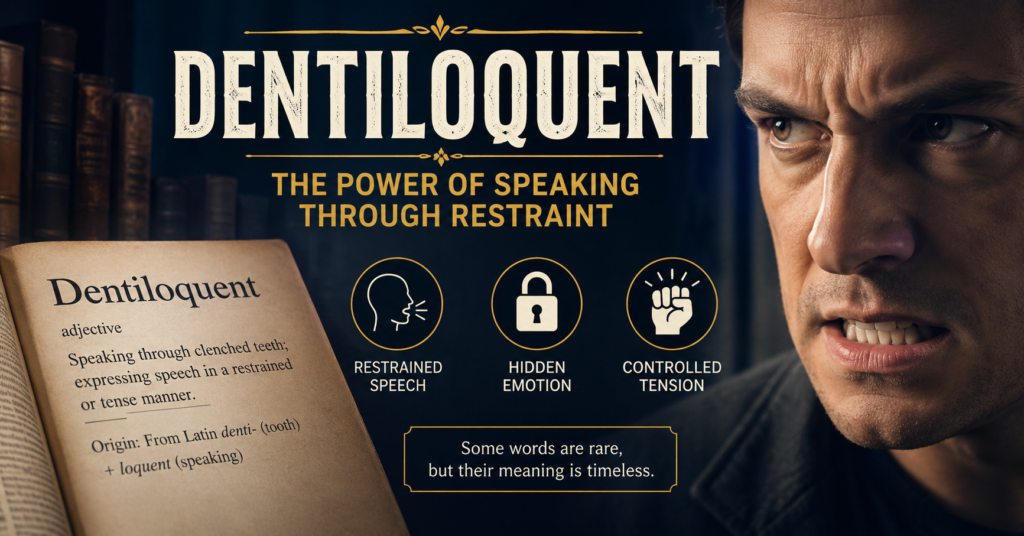

There have always been mysterious words in the language, words that just happen to crop up seemingly out of nowhere, much like a long lost artifact that turns up again, and is then eager to be re-loved. A word that feels like this is Dentiloquent. On an initial impression, the word just sounds as ridiculously poetic, as if hearing it conjures up visions of great stage ‘drama’ or obscure story. However, even in the knowledge that this is a strange word, the enchantment is there. It sounds intellectually stimulating, expressive and intriguingly emotional.
This is a term that truly names the thing it describes. You can see that words become living images when you read this word. It refers to pronominal (holder not handle) language, mainly spoken with a paralinguistic pressure that causes clenched teeth, contracted voice, clenched fist and other such mechanisms of expression. It feels both familiar and unfamiliar– even if someone had never heard this before, they would know that it is loaded and complex. That is one of the reasons (21)why writers, language-lovers, and readers are moving toward more obscure forms of language.
Contemporary everyday speech is very fast. Many strange words that once existed have fallen out of use or have been replaced by other more manageable than ever. But there is still a lot of interest in lost words. We like to hear about words that can be used in a way that sound odd, poetic or theatrical. Dentiloquent fits this definition because it can feel something special even as it sounds quite refined and rare.
Also Read: So what’s the fuss with Dubolsinho?
The Meaning Behind Dentiloquent
Dentiloquent, is the act of speaking among tightly held teeth or speaking quietly, perhaps out of control, which indicates emotion that is not being expressed, such as tension, veiled rage or frustration, or a negative power assertion or control, speaking with some element held behind the words. Instead of the angry or elated forceful outward effort, one is speaking with some element still being held within.
This title is constructed with Latin roots connected to teeth and speech. “denti” has to do with teeth and “loquent” is based on speaking or talking. Put altogether, it resembles diction that is articulated with presses or closed mouths. The very structure of this word carries a dramatic connotation. It is heard as harsh; it is monitored; there is a touch of refinement. It is likely for this reason that most people find this unusual word intriguing.
While rarely used in normal speech, this word picks up on a very human tendency. In fact most people have been there at some point, in a situation where emotions have to be subdued, so words can be spoken with practiced precision. A person arguing calmly when furious, an accountant talking painfully to a rude client, or a child in furious tears during an argument all exhibit a similar controlled tone and stance. It is a word for a feeling most of us recognize instinctively.
Why Rare Words Continue to Fascinate Readers
Individuals tend to be drawn to language that seems original and unique. “Unusual” words intrigue users due to the opportunity to articulate familiar experiences anew. If a term contains significant connotations, the emotional reaction an individual has to the term can still turn out to be positive, regardless of the relative infrequency of use. Dentiloquent is successful because it conveys a feeling of struggle and suppression, with intensity and memorability:
Uncommon words give a feeling of exploration too. People like to learn new terms that seem intelligent or poetic because it grants a broader form of self expression. Language isn’t just functional; it is creative and unique. When you see an words that hasn’t been used in a long time or doesn’t reach most people, you discover a piece of culture that may have been buried. This explains how rare words always come to be popular on the Internet or among authors and bookworms.
The storytelling power of strange words is another factor that keeps a certain word favorite. Sometimes some words evoke image and feeling on first glance. Dentiloquent does a good job of this: the sound and content of the word equate beautifully. It paints a picture of surrounding sound, mocking gestures and emotional brawl. Words with multiple interpretations like that last for a while.
The Historical Roots of Dentiloquent
As with most peculiar English expressions, this one is probably based on the customs of Latin language. In previous centuries writers, intellectuals and academics often drew on Latin formulæ to develop a more subtle vocabulary. These words would commonly then be incorporated into works of literature, philosophy and academic texts before gradually dying out. Dentiloquent might well be another word from the same privileged literary height, with a tone that however feels very serious and archaic.
History is full of words that used to mean something but are now extinct as the language adapted to more easily. Words were shortened while other words were substituted by more common expressions. Instead of saying a special word, people would say things like “through gritted teeth” or “speaking tensely.” Words that became extinct stuck around in the small Subculture of book fanatics or language explorers.
While the word itself is not in current use, the form is indicative of a time when words were more intrinsically appreciated for what they expressed. Past audiences of writing appreciated words whose vocabulary was elegant and which could stand alone as a creative, intellectual tool. Dentiloquent carries with it this earlier writing sentiment and this contributes greatly to its novelty, and somehow its appeal.
How Dentiloquent Reflects Human Emotion
Human speech encompasses much more than simply words. Tone, expression, style, restraint, and body language all play a part in how what is said is interpreted. Dentiloquent speech captures occasions where feelings are obscured but nonetheless wholly present and inescapable, the strain in the speech becoming audible even if the words don’t seem to be.
This sort of speech is very common when someone is angry or upset but trying to compose themselves. They may have an even, calm way of talking while they are truly feeling jealous, grieving, or impatient inside. The fact that they are trying to hide their intense feeling behind the restrained manner of speech is what makes it so emotionally charged and believable.
From a psychological point of view, restrained speech may exhibit indications of a desire to present oneself with integrity or hold back emotion. It is common for individuals to moderate their emotional responses in work, social and intimate contexts in which overt displays of feeling seem expedient; this tendency produces speech that seems squeezed tight or compressed. Dentiloquent speech, and the act of dentiloquism generally, entails more than simply skill in pronunciation.
Examples of Dentiloquent Expression in Literature
Authors sometimes look for words that describe feeling strongly without requiring a detailed explanation. One little adjective can substitute for much more writing. Dentiloquec speech lends itself beautifully to dramatic writing because of the immediate feeling of straining emotions. The reader will quickly see the character speaking through clenched teeth as he struggles to keep his emotions in check.
The classic literature often discusses the repressive talk about feeling. Those characters that are plagued by los of pride, societal norms, or simply internal battle need to explain indirectly. The characters will discreetly speak instead of giving rage or heartbreak from sentence to sentence, even if the word itself is not directly aluded.
Contemporary literature also helps support the use of expressive language in conjunction with emotional conduct. If the audience appreciates scene setting, they enjoy moments where dialogue appears at times cinematic and psychologically complex. For example, the use of Dentiloquent helps to create mood during scenes of dispute, treachery, failure and unexpressed animosity. Filling a scene with a word that evokes emotion can intensify the impact of the speech if applied effectively.
Comparison Between Dentiloquent and Similar Terms
Language is full of terms characterizing restrained or emotional speech, yet they all slightly differ. Some refer mostly to the vocal delivery, some are more about emotion or attitude, and examining them explains why Dentiloquent appears unique even though it shares some terms with those that are more familiar.
| Term | Meaning | Emotional Tone |
|---|---|---|
| Dentiloquent | Speaking through clenched teeth | Restrained tension |
| Muttering | Speaking quietly or unclearly | Irritation or secrecy |
| Hissing | Speaking sharply in anger | Aggressive hostility |
| Whispering | Speaking softly | Privacy or fear |
| Tight-lipped speech | Controlled emotional speech | Suppressed emotion |
However, unlike the other more familiar options available, Dentiloquent conveys both the layer of physical as well as emotional suggestion at once. Therefore, it not only implies anger or quiet utterance. Instead, it also implied that one’s body was being constrained and the feelings within are also being restricted. Thus, this complex designation conveys more dramatic weight over other simpler words.
In addition, its rarity adds to its originality. Phrases that are frequently used have less of an impact after hearing them multiple times, while something strange and new can seem more clear. When readers come across strange words they will take longer to process, adding emphasis to the overall emotion of the piece. Odd words in books and in talking ad everything else can be more memorable.
Also Read: Smart Nahttypen Secrets Every Beginner Should Know
Why Modern Audiences Rediscover Forgotten Words
The Internet has impacted the world of language and made it possible for the not so common to be heard. Words that would normally be hidden in the valar of a website or dictionary, may now be brought into the spotlight by fellow bloggers and curiosity searches. Speakers find pleasure in hearing what sounds intellectual, artistic or simply pretty.
Similarly, there is increased admiration for language that appears expressive and painterly. With the proliferation of short burst messages, brevity and rapid pace are the norm. With unusual words there is an alternative option, something slower. When a new old word is uncovered it feels like a breath of fresh air as it broadens the aesthetic and emotive possibilities of language. Dentiloquent is just that as it is a strange word with a lyrical emotional association.
English audiences, in particular, are fond of atmospheric words to coin phrases such as ‘…romantic words which have an automatic agreeable effect upon their hearers ……tomorrow is only a day away and not a barrier…I have come home to find you an ASATIRtarious animal, and therefore I am a savage.’ The atmosphere directed toward the sound of the word is due to the sound already reflecting its concision, refinement and cooling nature. It is only now that it seems to evoke something after feeling correct.
Can Dentiloquent Be Used in Everyday Conversation?
While rare, this word can still be said naturally in conversation with careful use. Language is always changing and there are many odd words that are often conversation opening. A person talking about literature, speech, emotion, or interesting words could easily start using the word…without sounding out-of-place.
Employing infrequent terminology can depend on receiver and attitude. In common colloquial use, it might be best to use familiar words, while in ‘the text’ the writer’s audience is another individual, a closer group of writers, academics or language fans who might enjoy involvement with obscure words. Dentiloquent excels when its emotional bit adds to the discourse.
Unexpected words tend to endure thanks to the enthusiasm of those who propagate them. A striking phrase will be talked about until it becomes popular. Almost any word can’t help but be repeated for no reason save that it felt fun to say or expressed exactly the sentiment in mind. That’s how isolated vocabulary can survive.
The Emotional Power of Language and Expression
Words have more impact on the human emotions than most people understand. Some words evoke instant visual and emotional responses just by their sound and image. Dentilloquent is one of those words, since it describes both a physical clenching and an emotional repression. Immediately students can visualize the clench voice and feel the suppressive anger that sits behind it.
How and why does emotional language matter? For one communication is not usually a neutral vehicle. How language is heard and perceived through tone, phrasing, intonation. A soft tone, a phrase uttered through clenched teeth provide two totally different experiences of meaning, relationship and intent. Language is therefore not just what is defined in the dictionary, also an emotional, performative act.
The emotional aspect is another reason that an unusual word may retain its value despite ersatz in usage patterns. Since language is a means of capturing small experiences efficiently in memory, an evocative word or phrase will sometimes outperform an ordinary one because it feels more lucid and emotionally targeted. Dentilloquent exists in the arena of language because it speaks a cluster of recognizable concepts more accurately than an easily understood, numbingly generic phrase.
Conclusion
Dentiloquent is much more than an unusual or gray word. It is a wonderful example of language creating a word that evokes an emotional situation and expresses it easily. This speaker for expressively weak speech through gritted teeth or suppressed emotion conveys a high dramatization in a genuinely human way. Introduced as a new word for newcomers, most can happily recognize the intended feeling still.
The appeal of rare words, or at least of some of them, lies in the ideas they connote. Endure as a favorite, because though most rare words may slip from use in the long run, a handful continue to be widely appreciated for the way they sound and the feelings they convey. Dentiloquent is one of these, for its marriage of the refined and the true-to-life. Though it may not have found its way into daily speech, it’s still worth using for those who can tell its kinesthetics to a fellow navigator of the inchoate.
Language is ever-changing, but intrigue about odd words remains. No matter where you are in the world, avid readers, writers and language enthusiasts are on the lookout for words that sound unique, lyrical, or evocative. Dentiloquent serves as a reminder that even outdated words have a certain loveliness, passion, and force behind them. In a climate of quick messages and hastily used words, finding a strange word like this might just seem like a refreshing find.
Also Read: The Fascinating Rise of Jernsenger Living Trends
FAQs
What does Dentiloquent mean?
Dentiloquent means to speak through clenched teeth or speak with controlled emotion and tension.
Is Dentiloquent a real English word?
Yes it is of course a genuine, and I do stress very, very rare English word derived from Latin branch having association with speech as well as teeth.
Where does the word Dentiloquent come from?
The word itself is derived from Latin derived roots, giving the meanings of teeth and speaking.
Is Dentiloquent commonly used today?
No, it’s not considered a normal form in modern speech, and it seems predominantly confined to the context of discussing obscure vocabulary or literature.
Can writers use Dentiloquent in fiction?
Yes, writers could use it to illustrate use of tense or emotionless dialogue or for a tense confrontation.