
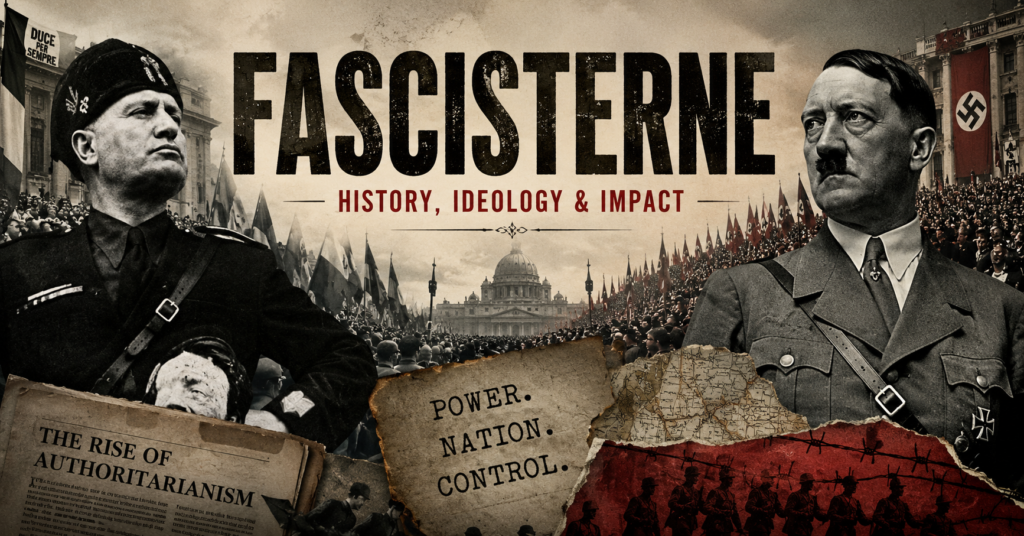

The term fascisterne is most commonly used in Scandinavian languages to refer to fascists, a political identity tied to one of the most controversial ideologies of the 20th century. To understand fascisterne, it is important to look beyond the word itself and into the historical environment that gave rise to fascist movements across Europe. These movements were not isolated phenomena but responses to political instability, economic crises, and social unrest following the First World War.
During the early 20th century, many societies were struggling with uncertainty, and this allowed extreme political ideas to gain traction. Fascisterne became a label associated with groups that promoted strict authority, national unity, and the suppression of opposition. While interpretations of the term can vary depending on context, it consistently points to authoritarian political movements that left a deep mark on modern history.
Today, fascisterne is used both in historical discussions and in modern political commentary, often carrying strong emotional weight. It is not just a descriptive term but also one that reflects the tension and conflict of the era it represents. Understanding it requires careful attention to both historical facts and the way language evolves over time.
Also Read Incredible Sodiceram trends that are changing interiors
Origins and Ideological Foundations of Fascisterne
The origins of fascisterne can be traced back to early 20th-century Europe, where political dissatisfaction created fertile ground for radical ideas. One of the most well-known early expressions of fascism appeared in Italy under Benito Mussolini, whose movement emphasized nationalism, centralized control, and loyalty to the state above individual freedoms. These ideas later influenced similar movements across the continent.
At its ideological core, fascisterne is associated with a belief in strong leadership, often rejecting democratic systems in favor of authoritarian rule. It also tends to emphasize unity through identity, whether cultural, national, or ethnic. In practice, these beliefs often resulted in the suppression of dissent and the concentration of power in a single governing authority.
Another major influence on the development of fascisterne was the political climate in post-war Germany, where economic hardship and social instability allowed extremist ideologies to flourish. This environment helped elevate figures such as Adolf Hitler, whose regime shared similarities with Italian fascism but also developed its own distinct and extreme characteristics.
Fascisterne in Europe Between Wars
The interwar period in Europe was a crucial stage for the rise and spread of fascisterne. Many countries were dealing with the aftermath of World War I, including economic depression, political instability, and widespread public dissatisfaction. In such conditions, fascist movements presented themselves as solutions promising order, strength, and national revival.
During this time, fascisterne gained political influence in several European countries. Italy became one of the earliest examples of a fascist state, while Germany followed a different but related path. Other regions also experienced smaller but significant fascist movements that reflected local concerns and national struggles.
The rise of fascisterne during this period was not inevitable, but it was shaped by a combination of fear, uncertainty, and the appeal of strong leadership. Many citizens supported these movements believing they would restore stability, although the long-term consequences would prove far more complex and often devastating.
Key Characteristics of Fascist Movements
| Characteristic | Description |
|---|---|
| Centralized Authority | Power is concentrated in a single leader or ruling group |
| Nationalism | Strong emphasis on national identity and unity |
| Anti-Democratic Structure | Opposition to multiparty democratic systems |
| Control of Media | Regulation or manipulation of public information |
| Militarization | Focus on military strength and discipline |
The table above highlights some of the defining traits commonly associated with fascisterne and related political systems. These characteristics are often used by historians to identify and analyze fascist movements across different countries and time periods. While not every movement displayed all of these traits in the same way, they provide a general framework for understanding how fascism operates.
It is also important to recognize that fascisterne is not a single unified system but rather a category that includes various movements with shared ideological elements. This means that while there are similarities, each historical example also has its own unique political and cultural context.
Understanding these characteristics helps clarify why fascisterne became such a powerful force in certain historical moments. It also provides insight into how similar patterns might emerge in different forms under specific conditions.
Social Impact and Public Response to Fascisterne
The rise of fascisterne had a profound impact on society, affecting everything from politics to daily life. In countries where fascist regimes gained control, public institutions were often reorganized to align with state ideology. This included education systems, media outlets, and cultural organizations, all of which were influenced by the ruling political structure.
Public response to fascisterne was deeply divided. Some individuals and groups supported the movement, believing it would restore national pride and economic stability. Others resisted, often facing significant consequences for their opposition. This division created lasting social tensions that continued even after the decline of fascist regimes.
Over time, the consequences of fascisterne became more widely understood, particularly as historical events revealed the extent of repression and conflict associated with these movements. The legacy of this period continues to shape political discussions and cultural memory in many countries today.
Also Read: Portar Leisa’s Astonishing Significance
Modern Interpretations of Fascisterne
In modern discussions, fascisterne is often used as a historical reference point but can also appear in political debates as a label for authoritarian tendencies. Its meaning can vary depending on context, which makes it important to approach the term with precision and care. Misuse or oversimplification can lead to misunderstandings about both historical and contemporary issues.
Historians today study fascisterne not only as a political system but also as a social phenomenon. This includes examining how ordinary people became involved in such movements and how propaganda, economic conditions, and fear contributed to their rise. These studies help provide a more complete picture of how fascist systems develop and sustain themselves.
Modern interpretations also focus on preventing similar patterns from emerging in the future. By analyzing the conditions that allowed fascisterne to gain influence, researchers aim to better understand the warning signs of authoritarian shifts in political systems. This ongoing analysis remains relevant in discussions about governance and democracy.
Why Fascisterne Still Matters Today
The historical significance of fascisterne continues to influence modern political and social thinking. Even though the original movements largely collapsed after World War II, the ideas and structures associated with them remain a subject of study and reflection. This helps societies better understand the risks of concentrated political power.
In educational contexts, fascisterne is often used as a case study to explore how political systems can change under pressure. It highlights the importance of civic engagement, institutional checks and balances, and public awareness. These lessons are considered essential for maintaining stable and open societies.
The continued relevance of fascisterne lies in its ability to remind us of how quickly political conditions can shift. By studying its history, people gain insight into the importance of protecting democratic values and ensuring that political systems remain accountable to the public.
Conclusion
fascisterne represents more than just a historical label; it reflects a complex period in European history marked by instability, ideological conflict, and profound social change. By examining its origins, development, and consequences, we gain a deeper understanding of how political movements can shape entire societies. While the era of classical fascist regimes has passed, the lessons drawn from it remain highly relevant. They serve as a reminder of the importance of vigilance, informed citizenship, and respect for democratic principles in maintaining balanced governance.
Also Read: Why Uncuymaza Became an Intriguing Internet Trend
FAQs
1. What does fascisterne mean?
fascisterne is a term used in Scandinavian languages to refer to fascists, or followers of fascism.
2. Where did fascisterne originate historically?
The concept is linked to early 20th-century Europe, particularly Italy and Germany, where fascist movements first rose to power.
3. Is fascisterne still used today?
Yes, it is used in historical discussions and sometimes in modern political commentary.
4. What are the main ideas behind fascisterne?
It is generally associated with authoritarian leadership, nationalism, and centralized political control.
5. Why is fascisterne an important topic to study?
It helps explain how extreme political systems develop and the impact they can have on societies.