
Moving across the country is one of the biggest expenses most people take on outside of a mortgage or a car purchase — and the price swings wildly depending on how you do it. This guide breaks down real costs by move type, distance, and home size, plus the hidden fees that catch people off guard, so you can budget accurately before you book anything.
The Short Answer
For a typical two-to-three bedroom home moving 1,000+ miles, expect to pay:
- DIY truck rental: $1,500–$3,500
- Portable moving container (PODS-style): $3,000–$6,000
- Full-service moving company: $5,000–$10,000+
The exact number depends on distance, how much you own, the season you move in, and how much labor you’re willing to do yourself.
Cost by Moving Method
1. Renting Your Own Truck
This is the cheapest option if you have the time and physical ability to load, drive, and unload everything yourself.
What you’re paying for:
- Truck rental (base rate + mileage)
- Fuel — a fully loaded truck can get as little as 8–10 mpg
- Optional equipment: furniture dollies, moving blankets, tow-dolly for a second vehicle
- Insurance/damage waiver
Typical total for a 1,000+ mile move: $1,500–$3,500
Best for: People comfortable with manual labor, driving a large truck, and coordinating the whole move themselves.
2. Portable Moving Containers
A container is dropped at your home, you load it at your own pace, and the company ships it to your new address.
What you’re paying for:
- Container rental and delivery both ways
- Long-distance shipping fee (this is the big variable — it scales with distance)
- Storage-in-transit if you need a delay between homes
Typical total for a 1,000+ mile move: $3,000–$6,000
Best for: People who want to load at their own pace without driving a truck themselves, or who need a storage gap between move-out and move-in dates.
3. Full-Service Movers
Movers pack (optionally), load, drive, unload, and sometimes unpack for you.
What you’re paying for:
- Labor (loading and unloading crews)
- Truck and fuel
- Distance-based long-haul fee
- Packing materials and packing labor, if you choose full-service packing
- Insurance/valuation coverage
Typical total for a 1,000+ mile move: $5,000–$10,000+, with larger homes and long distances pushing well past $10,000
Best for: People with limited time, physical limitations, or enough budget to prioritize convenience.
Cost by Home Size
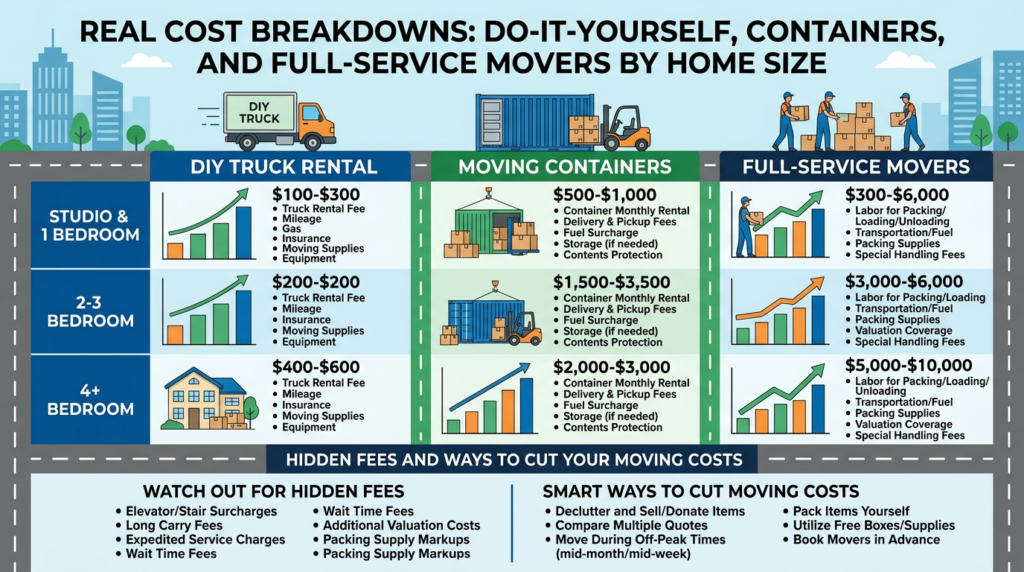
| Home Size | DIY Truck | Container | Full-Service |
|---|---|---|---|
| Studio/1BR | $800–$1,800 | $1,800–$3,000 | $2,500–$4,500 |
| 2–3BR | $1,500–$3,500 | $3,000–$6,000 | $5,000–$10,000 |
| 4+BR | $2,500–$5,000+ | $5,000–$9,000+ | $9,000–$15,000+ |
Hidden Costs People Forget to Budget For
- Fuel for your own vehicle(s) if you’re driving separately from the moving truck
- Lodging for multi-day drives
- Packing materials — boxes, tape, bubble wrap add up faster than expected; used boxes from local stores can cut this significantly
- Tipping movers — typically 5–10% of the total cost, split among the crew
- Temporary storage if your move-in date doesn’t line up with move-out
- Utility setup/deposit fees at the new home
- Pet transport if flying or boarding is needed for the trip
- Elevator or long-carry fees some movers charge in apartment buildings
How to Cut Your Moving Costs
- Move mid-month and midweek. Moving companies charge premium rates on weekends and at month-end, when demand spikes.
- Purge before you pack. Every box you don’t have to move saves weight, truck space, and packing materials. Sell or donate anything you haven’t used in a year.
- Get at least three quotes. Prices for the same move can vary by thousands of dollars between companies.
- Ask about binding vs. non-binding estimates. A binding estimate locks in your price; a non-binding one can balloon on move day.
- Pack it yourself, even with full-service movers. Packing labor is often the most expensive line item — doing it yourself while still paying for loading/driving/unloading is a solid middle ground.
Bottom Line
If your budget is tight and you have the time and physical ability, a DIY truck rental will save you the most money. If you want a middle ground, a portable container splits the difference between cost and convenience. If your time or ability is limited, full-service movers cost more but remove nearly all the physical burden.
Before booking anything, get quotes from at least three sources for your specific route and move date — long-distance pricing changes constantly based on demand and season.
Planning your move? [Compare quotes from top-rated moving companies] and [browse packing supply essentials] to get started.